
Sterling County Civil Docket Searches
The main free online route is re:SearchTX, which covers participating e-filed noncriminal cases. Its official guide offers four paths: Cases, Filings, Text in Documents, and Hearings. Sterling County posts no direct civil docket URL of its own. It also lists no local cause-number format. Separately, eFileTexas lists Sterling civil as mandatory with “Full Search.” But a filing-system status is not the same thing as a free, complete docket.
Know your court first. Decide whether the case belongs to 51st District Court, constitutional County Court, or Justice Court. Gather both party names, the filing year, and the exact cause number. Search with a formal party name. Then verify the court on anything the search returns.
- Choose the court level based on the kind of civil claim.
- Search re:SearchTX through Cases, Filings, or Hearings with the best known name or number.
- Open Case Details and confirm Sterling County, the court, parties, filing date, and status.
- Read filings, motions, settings, orders, and disposition in date order.
- Ask the District, County, or Justice clerk for any missing filing or certified judgment.
Sterling Civil Full Search Explained
The eFileTexas active-courts matrix shows Sterling civil filing as mandatory and its case-search level as Full Search. Full Search signals broader integration than Limited Search. It promises no such thing as a complete public window, since an old Sterling County civil docket, a sealed filing, an image, or an order may still sit behind an account or a fee.
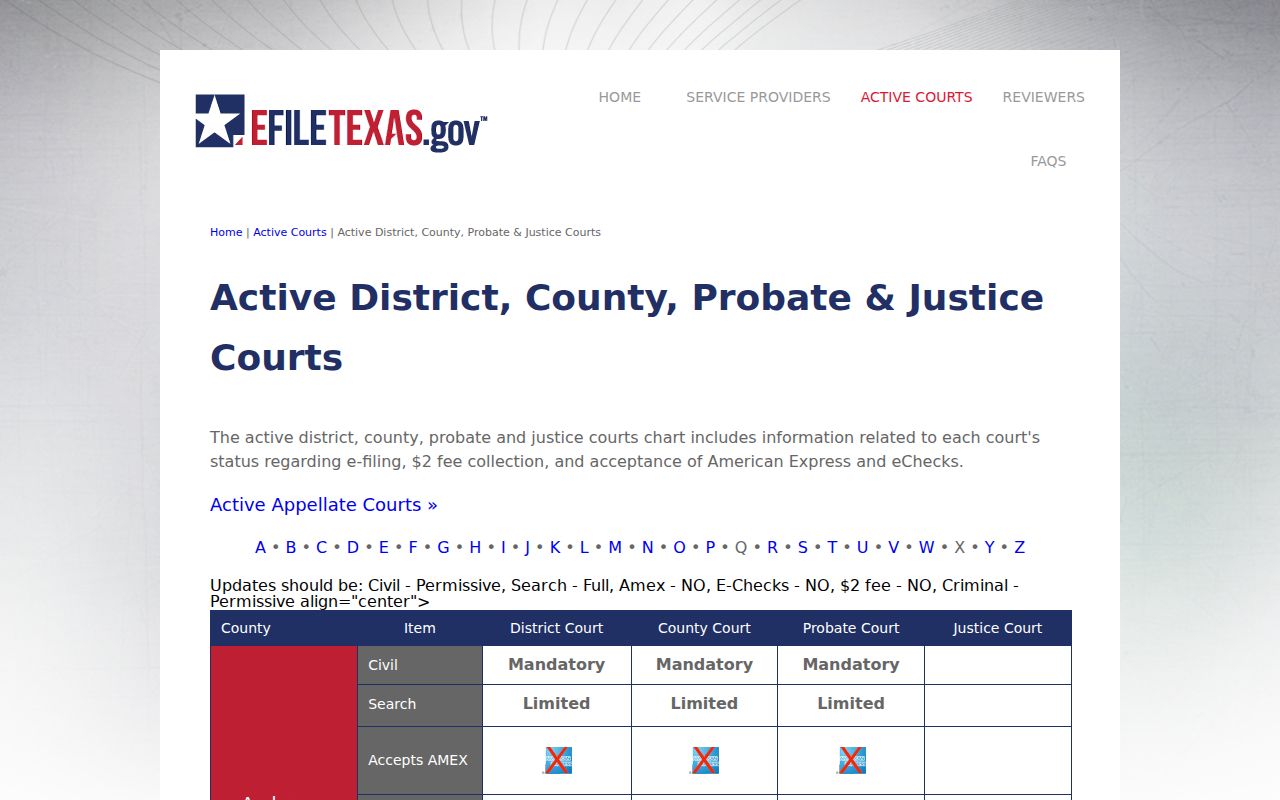
The Sterling row sets the search level. Copies and certifications stay with the proper clerk. eFileTexas also handles submissions. But a submitted status only means a document entered the filing workflow. It does not mean a judge signed it. Nor does it mean the public can open its image. When exact terms matter, check the docket event. Then get the order itself.
Civil Dockets: What They Show
A Sterling County civil docket opens with case identity and party roles. From there, the event history can list the original petition, citation issued and returned, an answer, a counterclaim, motions and responses, setting notices, mediation filings, orders, judgment, and post-judgment steps. Titles track movement well. They do not reproduce every fact inside the filed paper.
| Cause Number | The exact assigned identifier; no local format such as YYYY-CV-number has been verified for Sterling. |
|---|---|
| Case Style | The formal caption and the plaintiff/petitioner and defendant/respondent roles. |
| Filings | Petitions, answers, motions, responses, returns, and available document metadata. |
| Settings | Hearing or trial type and date when published; newer resets replace older settings. |
| Disposition | Judgment, default, agreed judgment, nonsuit, DWOP, dismissal, or trial result. |
After judgment, expect entries such as an abstract, a writ, garnishment, a turnover proceeding, satisfaction, a bill of costs, or a notice of appeal. Read the signed instrument itself to learn its legal effect.
Sterling Civil Results Have Four Layers
The re:SearchTX landing page is the statewide starting point for participating case types. Signing in or registering may be required first. Only then do the search functions open. Official materials describe records reaching back to 2016 in the collection discussed. Older causes may need a direct request to the clerk.
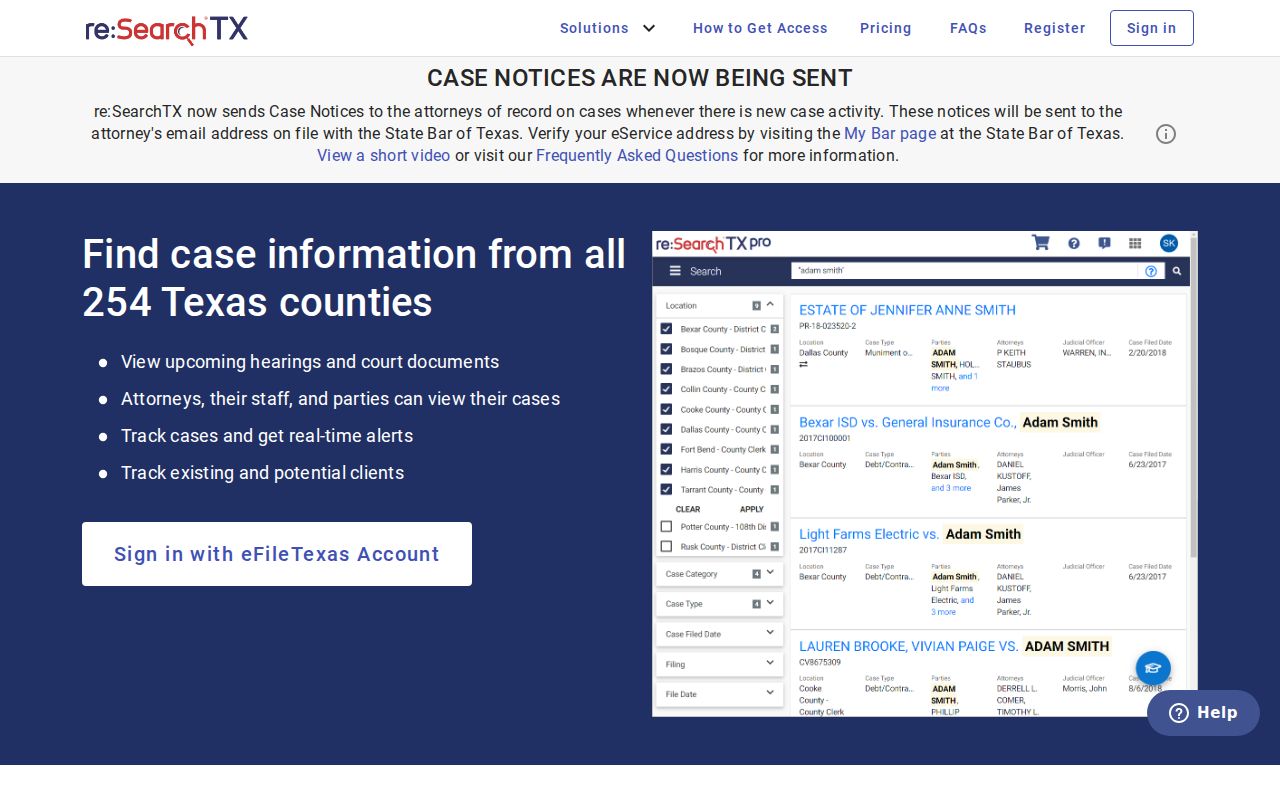
The public interface appears here without any private party or case information.
| Search path | What it locates | Next check |
|---|---|---|
| Cases | Case-level results and Case Details | Court, county, style, status |
| Filings | Filing events and metadata | Filed date and document availability |
| Text in Documents | Text within available files | Access or purchase limits |
| Hearings | Hearing types and details | Latest setting and court confirmation |
What Cases Fill the Civil Docket
The 51st District Court handles the big civil matters, family cases, and title-to-land disputes. The constitutional County Court keeps its own civil and probate work. Under Texas Government Code section 26.316, Sterling County Court also holds concurrent justice-level civil and criminal jurisdiction. That overlap matters. Small claims and evictions generally go to the countywide Justice Court. They skip the District Clerk.
The Government Code text explains why County Court and Justice Court civil jurisdiction can overlap in Sterling County.
- Major civil disputes and title-to-land matters in 51st District Court
- Family matters, with added access limits for protected information
- County Court civil matters and probate filings
- Small claims in the countywide Justice Court
- Evictions and forcible-entry-and-detainer cases in Justice Court
Sterling City has no municipal court. A city resident's small claim or eviction therefore never lands on a city civil docket. The Sterling City court-record route points residents to the county court level that actually holds the case.
Choose the Sterling Civil Court First
A broad name search returns the wrong matter when the court level is ignored. For a district civil or family case, request records from the District Clerk and name the 51st District Court. The official Sterling County District Clerk page identifies Jerri McCutchen, the courthouse counter, contact details, and office hours.
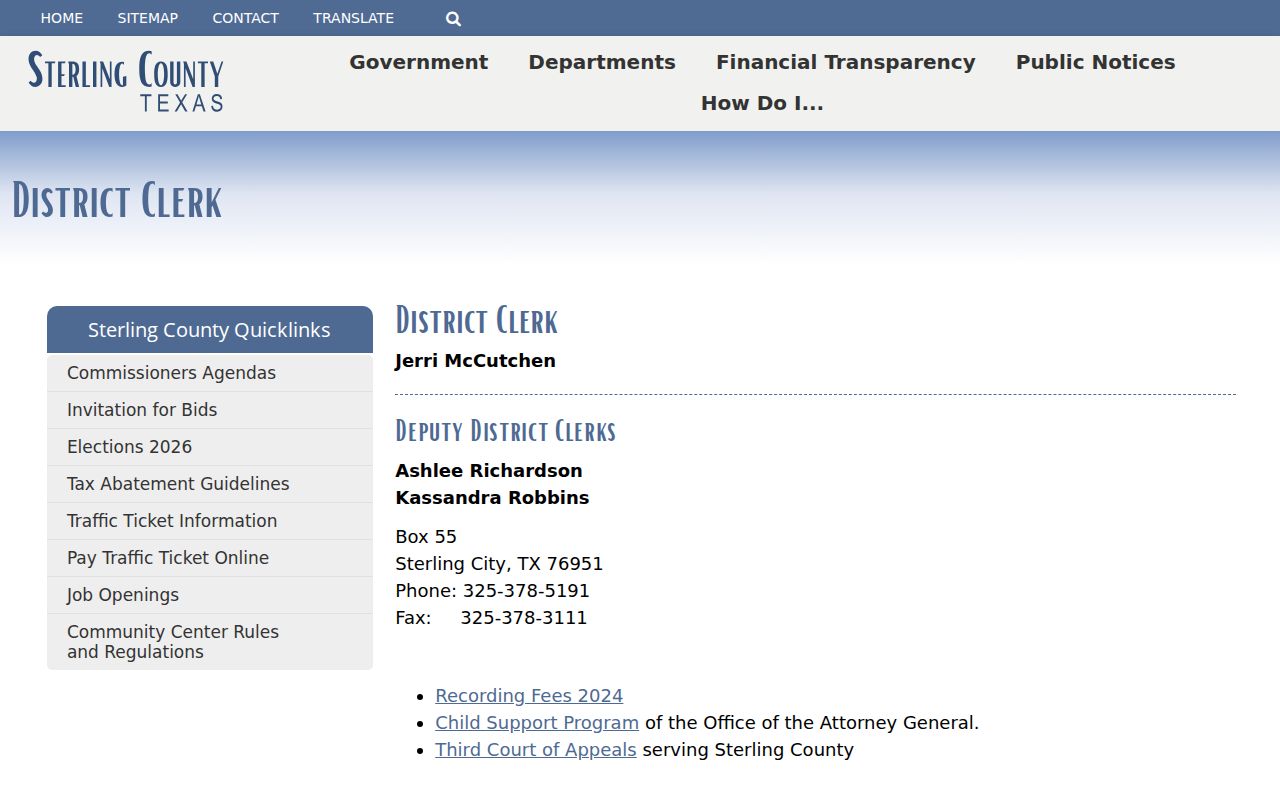
The District Clerk keeps Sterling's district-level civil and family files.
| Court | Typical civil docket | Custodian |
|---|---|---|
| 51st District Court | Major civil, family, and title-to-land cases | District Clerk |
| County Court | County civil, probate, and concurrent justice work | County Clerk |
| Justice Court | Small claims, evictions, and other justice civil matters | Justice Court office |
For County Court or probate work, use the Sterling County Clerk page. It documents the separate County Clerk role along with local recording-fee information.
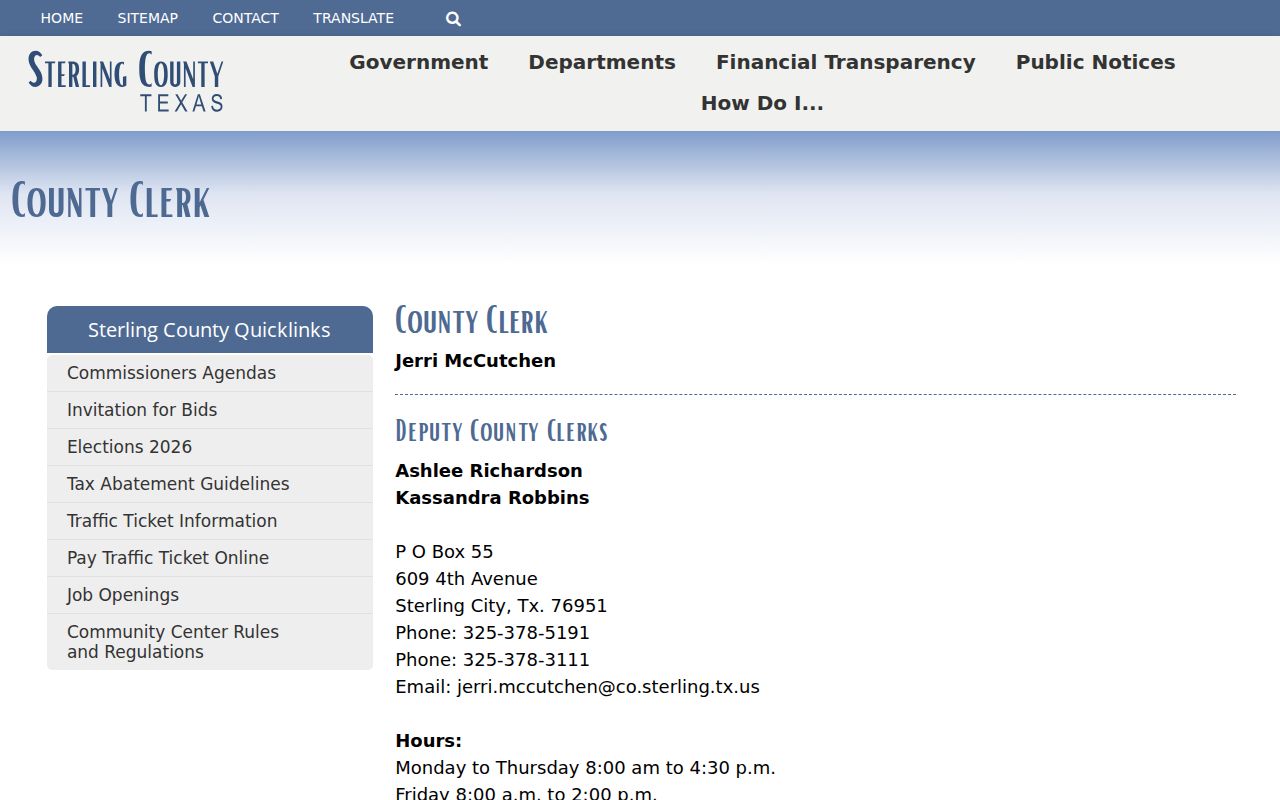
That page helps separate County Clerk records from files the same official keeps under District Clerk authority. The reason is that the statutory roles stay distinct. Both offices share a phone number, a courthouse, and P.O. Box 55. Small claims and evictions go through the Justice Court at (325) 378-3761.
Hearings on the Civil Docket
A hearing entry may show only a setting type and date. The notice or scheduling order supplies the controlling details. Civil events can include motion hearings, temporary-orders settings, mediation deadlines, pretrial conferences, bench trials, or jury trials. After a continuance, older entries stay in the history. So use the newest signed order or notice. Confirm by phone when the online case shows no current event.
The 51st District Court's civil and family coordinator works by email only. Reach the coordinator through the district court page. A coordinator can address settings, but filed records still come from the clerk. The county's public-notice calendar is not a case calendar. It carries no party, cause-number, judge, or courtroom fields. For a broader date workflow, try the Sterling County court schedule.
Civil docket flow: Petition › Service › Answer › Motions and Discovery › Setting › Judgment › Enforcement or Appeal
Sterling Civil Outcomes in Plain Terms
Sterling County posts no local list of civil codes. You may still see Texas terms spelled out or shortened on the docket, but the judge's signed order is what actually settles the outcome.
- Default judgment
- A judgment entered after a properly served party fails to answer or appear as required.
- Agreed judgment
- The parties' agreement entered as a court judgment.
- Nonsuit
- A plaintiff's withdrawal of a claim, often without a ruling on its merits.
- DWOP
- Dismissal for want of prosecution when a case is not pursued.
- Dismissal with or without prejudice
- The order controls whether the claim may be brought again.
A settlement note only tells you the sides reached a deal. It does not lay out the terms for the public. An "appeal" entry works the same way: it shows a review was requested, nothing more. Sterling civil appeals move up a level. The case goes through the Third Court of Appeals of Texas.
When a Sterling Order Is Missing
On re:SearchTX, a filing event can show up while its image stays locked, restricted, or behind access controls. Start with the event date and title. Then ask the clerk for that exact filing or signed order by name rather than requesting everything in the case. A precise request should list the court, cause number, party names, filing year, document title, and date.
You can reach the District and County Clerk by phone at (325) 378-5191, visit at 609 4th Street, or mail P.O. Box 55, Sterling City, Texas 76951. Some older civil causes may predate the statewide collection described in official reports. Ask staff whether they need a year-and-court search and whether your copy will be plain or certified. Sterling has not posted a verified court-copy fee schedule, and the County Clerk's $25 first-page and $4 additional-page figure is a recording fee, not a confirmed civil case-copy charge.
Record distinction: A docket line proves that an event was entered. Only the filed document shows its full text, and only the clerk can issue a certified copy.
Who Can See Civil Dockets
Most civil court records are open to anyone. Family, juvenile, adoption, CPS, sealed, and personally identifying information can still be limited or redacted. A case may show its basic metadata while an attachment stays hidden. Sealed matters sometimes display a restricted marker. Others show a narrow header, or no public result at all. So a missing online result does not prove that no Sterling County civil docket exists.
Key Rules:
Texas Rule of Civil Procedure 76a presumes covered court records open and sets standards, notice, and hearing steps for sealing.
Texas Family Code Chapter 58 limits public access to juvenile records.
OCA's court-record policy explains that case records and Rule 12 judicial administrative records follow different access routes.
Send a specific written request to the clerk who holds the case record. That is not the same as filing a Texas Public Information Act request with an executive agency. Ask what portion is public, and whether redaction, authorization, or a court order is required.